Claude Fable 5: What Developers Need to Know
Claude Fable 5: What Developers Need to Know
Anthropic just shipped its most capable model to the public. Claude Fable 5 launched on June 9, 2026 — the most capable model Anthropic has ever released to the general public. Zylo
This isn't just a version bump. Here's what actually matters if you're a developer.
What Is Fable 5?
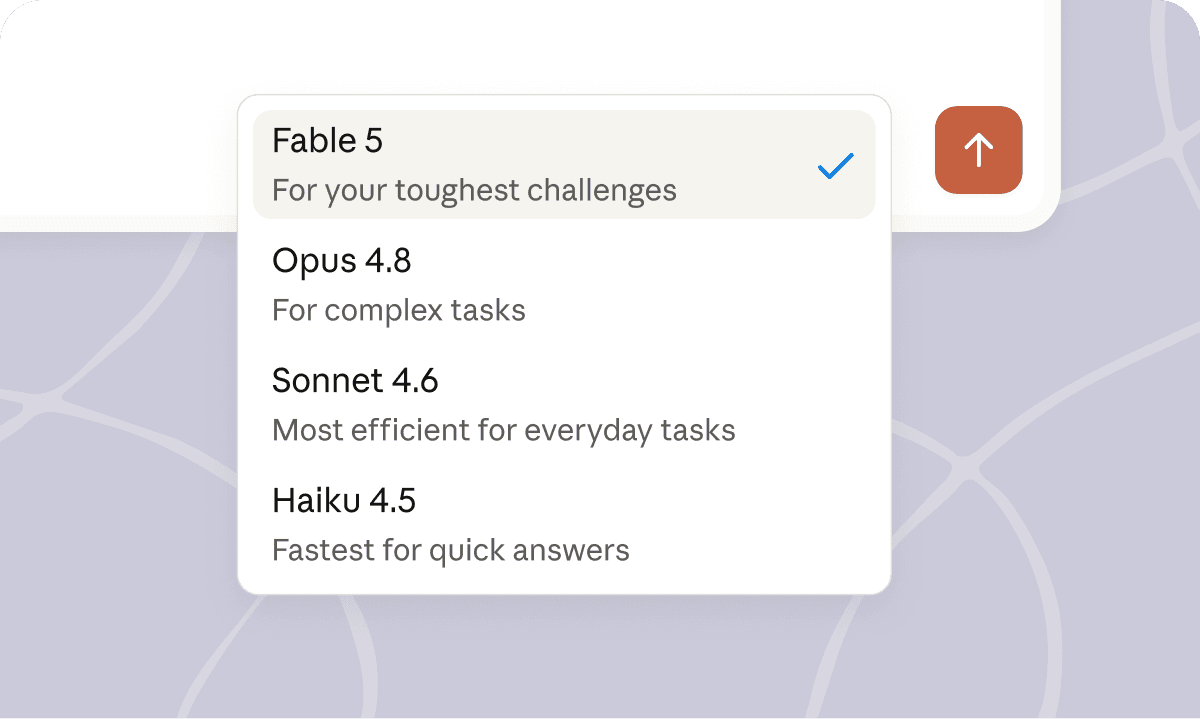
Anthropic's model lineup now spans four tiers: Haiku, Sonnet, Opus, and the new Mythos class — with Fable 5 being the public-facing version of that top tier, bringing Mythos-level capabilities to all customers with strong safeguards. Entrepreneur Loop
Alongside Fable 5, Anthropic released Claude Mythos 5 for a small group of cybersecurity defenders and infrastructure providers — the same underlying model, but with some safeguards lifted. The naming is intentional: "Fable" from the Latin fabula — that which is told — is akin to the Greek mythos. What separates the two is not the model but the guardrails. Zylo
In high-risk domains like cybersecurity and biology, Fable 5 automatically reroutes queries to Claude Opus 4.8. This fallback triggers in less than 5% of sessions on average, and you won't be charged Fable prices for rerouted requests. google
What It Can Actually Do
Software Engineering
Stripe reported that Fable 5 compressed months of engineering into days. In a 50-million-line Ruby codebase, the model performed a codebase-wide migration in a day that would otherwise have taken a whole team over two months by hand. google
On Cognition's FrontierCode evaluation, which tests whether models can pass difficult coding tasks while meeting the standards of high-quality production codebases, Fable 5 scores highest among frontier models. Medium
Vision
Fable 5 is the new state-of-the-art model for vision tasks. It can extract precise numbers from detailed scientific figures and rebuild a web app's source code from screenshots alone. Earlier Claude models struggled to play Pokémon FireRed even with complex helper harnesses — Fable 5 completed the game with a minimal, vision-only harness. google
Long-Context and Memory
Fable 5 handles complex tasks that previous models could not sustain, executing coding and knowledge work tasks for extended periods without intervention. The model updates its own skills based on learnings, develops its own harnesses and evaluations, and verifies its work — a form of proactive self-verification. ModallEntrepreneur Loop
Pricing
Fable 5 and Mythos 5 are priced at $10 per million input tokens and $50 per million output tokens — less than half the price of Claude Mythos Preview. The existing 90% input token discount for prompt caching still applies. google
How to Access It
Claude Fable 5 is generally available on the Claude API, Claude Platform on AWS, Amazon Bedrock, Vertex AI, and Microsoft Foundry. Nxcode
bash
# Model string
claude-fable-5-20260609
Through June 22, Fable 5 is included in Pro, Max, Team, and seat-based Enterprise plans at no extra cost. On June 23, Anthropic will require usage credits, with plans to restore it as a standard subscription feature as soon as possible. Elementor
One requirement: using Fable 5 requires 30-day data retention for safety monitoring. It is not available under zero data retention. Nxcode
Using Fable 5 in Flutter Apps
If you built your app with a dynamic AI provider system where the model is pulled from Firestore rather than hardcoded, you can swap to Fable 5 from your admin panel with zero app update:
dart
// In your Firestore ai_config/claude document
'model': 'claude-fable-5-20260609'
The higher output price matters at scale. For most apps with moderate usage it's manageable — but for high-volume consumer apps with free tiers, watch your costs carefully.
Fable 5 vs Sonnet 4 — When to Use Which
Use case | Recommendation |
|---|---|
Simple Q&A chatbot | Sonnet 4 — cheaper, fast enough |
Complex code generation | Fable 5 — significantly better |
Multi-step agentic tasks | Fable 5 — built for this |
High-volume consumer app | Sonnet 4 — cost control |
Conclusion
Fable 5 shows exceptional performance across software engineering, knowledge work, and vision — and the broad release is possible because of new safeguards that block responses in specific high-risk areas. MindInventory
For developers, the tradeoffs — higher price, 30-day data retention, occasional Opus fallback — are manageable. The capability jump is real.
What's next? Check the full Anthropic announcement for the complete benchmark breakdown, and review the API docs for migration notes.
For more official blog : https://bit.ly/43lYZbP
Published on bidev.site — Flutter and AI tools from a developer building in production.
Tagged in